
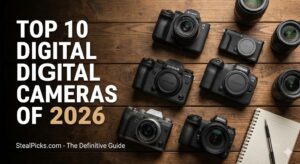

Smartphones have plateaued. The iPhone 16 and Pixel 10 are amazing, but they still can't fake physics. If you want real background blur, low-light performance without "AI smudge," and the joy of tactile dials, you need a dedicated camera.
2026 has been a golden year for photography. We have seen the rise of "AI-assisted autofocus" that literally never misses, and compact cameras making a massive comeback (thanks, TikTok).
We tested dozens of bodies—from $500 starter kits to $6,000 professional workhorses—to find the top 10 cameras worth buying right now.
Quick Summary
The Editor's Choice: Fujifilm X100VI
It is the most viral camera in the world for a reason. The 40MP sensor, built-in IBIS, and stunning film simulations make it the perfect "Everyday Carry." It makes photography fun again.
Check Stock Availability →The Top 3: Detailed Breakdown


The Best of the Rest
The video king. 8K raw video and 45MP stills make this the go-to choice for YouTubers who also do professional photography. The overheating issues of the Mark I are completely gone.
Check Price →It fits in your jeans pocket but has a massive APS-C sensor. The ultimate stealth camera for street snaps. The new monochrome mode is stunning.
Check Price →A 1-inch sensor on a tiny gimbal. If you walk and talk, nothing is smoother or easier to use. The low light performance destroys any GoPro.
Check Price →Interchangeable lenses for under $1000. It uses the same sensor as the expensive FX30 cinema camera but in a cheap plastic body. The best way to start a YouTube channel.
Check Price →Tiny, cute, and powerful. It essentially puts a great sensor in a body the size of a toy. Great autofocus, but limited lens selection compared to Sony.
Check Price →$6,000 fixed lens camera. Is it worth it? For the "Leica Look" and build quality, yes. It is jewelry that takes incredible 60MP photos.
Check Price →Better battery life than GoPro. If you need something indestructible for surfing or biking, this is it. The color science has improved massively this year.
Check Price →How to Choose (Sensor Guide)
The most important spec is the sensor size. Here is the cheat sheet:
- Full Frame (Sony A1, Nikon Z6): The Pro Standard. Best low light, blurriest backgrounds. Expensive lenses.
- APS-C (Fuji X100VI, Ricoh GR): The "Sweet Spot." Great quality, much smaller lenses. Perfect for travel.
- Micro 4/3 (Panasonic GH7): Smaller sensor, amazing video stabilization. Good for wildlife (extra reach).
- 1-Inch (DJI Pocket 3): A big step up from phones, but not quite "Pro" photo quality.
Frequently Asked Questions
Does megapixels matter?
Not really. Anything above 24MP is plenty for Instagram and even large prints. High megapixels (40MP+) are only useful if you crop your photos heavily.
Should I buy a kit lens?
For beginners, yes. But the biggest upgrade you can make is buying a "Prime Lens" (like a 50mm f/1.8). It will give you that blurry background look instantly.
Are DSLRs dead in 2026?
Effectively, yes. Mirrorless cameras are smaller, faster, and have AI-powered autofocus that old DSLRs simply cannot match. We do not recommend buying a new DSLR today.
Do I need 8K video?
No. 8K files are massive and hard to edit. For 99% of creators, high-quality 4K (over-sampled) is far more important and practical.
Can I use these as a webcam?
Yes. Most modern cameras (Sony, Canon, Nikon, Fuji) support USB streaming. You just plug them into your laptop via USB-C and select them as a webcam in Zoom or Teams.